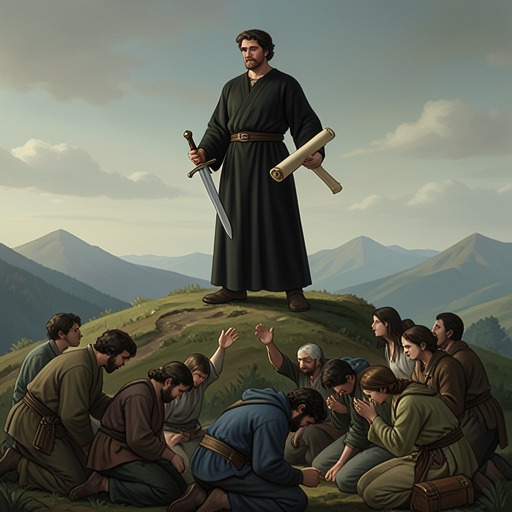
Perkin the Flea
Fire & BloodPerkin the Flea was a hedge knight whose rise in King’s Landing came amid the breakdown of royal government known as the Moon of Madness. He crowned his young squire Trystane as a rival king, built a following from the city’s dispossessed and armed men, and helped drive Rhaenyra Targaryen from the capital. His fortunes then reversed: after abandoning the kingship he had helped create, he was condemned for treason and implicated in Aegon II’s murder. At the executions, he asked to join the Night’s Watch, a request that spared his life and opened the same escape to many of his fellow prisoners.
Identity and Rise to Power
Perkin appears in the account as a hedge knight operating in a city where authority had fractured into competing factions. During the long night when the Shepherd held sway over part of King’s Landing, Perkin crowned his own squire, Trystane, and presented him as a son of the late King Viserys. The claim gave a makeshift court a royal figure around whom to gather. Perkin then used the custom that any knight could make another knight to dub the sellswords, thieves, and butcher’s boys who flocked to Trystane’s banner. Hundreds pledged themselves to the cause, converting a small act of self-coronation into a street movement with an armed following.
The episode established Perkin’s characteristic political method: he did not command through an established lordship or royal office, but assembled followers by offering them status and a place in a new order. The new knights were a motley force, yet their numbers and the disorder of the capital gave them practical influence. When the city’s surviving watchmen and other forces struggled to restore control, Perkin’s growing band became one of the powers contending for the streets.
Trystane’s Rule and the Fall of Rhaenyra
After Rhaenyra’s forces suffered severe losses and the queen fled the city, Perkin’s faction gained ground. Trystane, now styling himself King Trystane Truefyre, sat the Iron Throne while Perkin recruited surviving gold cloaks and expanded his control of the gates. His regime repealed Rhaenyra’s unpopular taxes and distributed treasury coin among its supporters. It also cancelled debts, raised sixty of Perkin’s gutter knights to the nobility, and offered the poor access to game in the kingswood. These decrees linked popular promises with rewards for the armed group on which Perkin’s authority depended.
The rival kings’ power did not remain fixed. The Shepherd’s following dwindled, while people who had looked to the Red Keep in hunger or fear turned increasingly toward Trystane’s court. Perkin’s force came to control four of the city’s seven gates and more than half of its wall towers. When Lord Borros Baratheon arrived with the stormlanders, however, the position collapsed. The city’s walls were unmanned and the gates undefended; Perkin’s banners were hauled down and Aegon II’s raised in their place. Perkin was in the Red Keep beside Queen Alicent Hightower when Borros asked where the pretender was. Perkin answered that Trystane had been taken and chained. His response marked the end of the kingship he had created: he had helped raise his squire to the throne, but could not preserve either the boy’s rule or the cause that had sustained it.
Defeat, Reversal, and Accusation
Perkin’s conduct after the defeat became central to his later condemnation. Trystane was brought before Aegon II and sentenced to die for high treason. Perkin stood with the king during the proceedings, and his presence, according to Mushroom’s account, broke the young claimant’s defiance. Trystane asked only to be made a knight before his death; Aegon granted the request, and the boy was dubbed Ser Trystane Fyre before being executed. Perkin, who had made Trystane a king, was thus present when the restored monarchy judged and killed him.
Perkin’s own position shifted again after Aegon’s return. When Ser Alfred Broome crossed the drawbridge to Maegor’s Holdfast, where Prince Aegon was being held, Perkin and six of his gutter knights blocked the way. Perkin declared that there was a new king and shoved Broome from the drawbridge. The incident was part of the turncloaks’ move against the existing royal order. In the subsequent inquiries into Aegon’s murder, twenty-two lesser figures were condemned alongside the principal conspirators. Many were men who had received their doubtful knighthoods from Perkin during the city’s turmoil; they said they had acted on his orders. The account treats his guilt as certain, while the judgment also rested on the broader charge that he had repeatedly changed allegiance, helped expel Rhaenyra, raised Trystane in her place, and then abandoned the squire to save himself.
Judgment and the Taking of the Black
Cregan Stark condemned Perkin for treason, but the sentence did not immediately end in execution. On the morning appointed for the condemned men to die, Perkin had drawn the lot to go first. Asked for his final words, he requested permission to take the black. Cregan, as a northern lord mindful of the Night’s Watch’s need for men, ordered his men to raise Perkin to his feet rather than execute him. Seeing a possible reprieve, the other prisoners began making the same request. The appeal spread through the assembled condemned, including gutter knights, servants, royal officers, three Kingsguard, and Grand Maester Orwyle; all were spared under the same rationale.
Perkin’s survival came through the very institution whose customary needs could override the sentence of a southern court: the Night’s Watch. His request transformed a personal bid for deliverance into a collective reprieve. The account records that he was spared, but does not describe his life beyond that decision.
Narrative Role
Perkin’s rise and fall illuminate how quickly royal symbols could be appropriated when the capital’s institutions failed. A squire crowned by a hedge knight could command a following, sit the Iron Throne, and issue decrees; the same improvised kingship collapsed when a stronger army entered the city. Perkin’s made-to-order knighthoods gave the poor and lawless a route into political violence, while later allowing the victors to identify a network of subordinate participants in the king’s murder.
His shifting loyalties also make him a measure of the political disorder around him. He helped displace one queen, elevated a squire as king, accepted the return of Aegon II, and then resisted the king’s authority when the turncloaks moved against him. The final reversal is pointed: the man who had used knighthood to manufacture a following survived because he asked to exchange the consequences of his actions for service at the Wall. The chronicle leaves that survival as an escape from immediate execution, not a restoration of power.